10 Tips for Choosing the Right Industrial Fans?
Choosing the right Industrial Fans is not a simple matter of comparing diameter, speed, and price. The correct decision affects airflow, worker comfort, energy use, maintenance, and production reliability. A fan that looks powerful in a catalogue may perform poorly beside a filter, elbow, damper, or long duct.
The U.S. Department of Energy’s Improving Fan System Performance: A Sourcebook for Industry explains that fan-system efficiency depends on the entire air-moving system, not only the fan motor. Its guidance highlights opportunities to reduce pressure losses, improve controls, and avoid oversized equipment. The International Energy Agency also reports that electric motor systems represent a major share of global electricity consumption. This makes fan selection an operational decision, not merely a purchasing task. It can influence monthly energy bills for years.
Industrial ventilation specialist Roger Legg has emphasized that “good ventilation begins with understanding the process.” That principle deserves attention. The dust load, temperature, humidity, corrosive atmosphere, operating schedule, and required air changes all matter. A clean workshop and a cement plant cannot use the same selection logic.
This guide presents 10 practical tips for choosing Industrial Fans, from calculating system resistance to checking noise, safety, controls, and lifecycle cost. Some recommendations may seem obvious. They are still frequently missed. In real facilities, imperfect measurements often produce imperfect choices. Recheck the airflow data. Inspect the ductwork. Question optimistic efficiency claims. A reliable selection combines manufacturer curves, field experience, recognized standards, and honest operating assumptions. The cheapest fan may be inexpensive only on the invoice.
Define the Airflow and Pressure Requirements
10 Tips for Choosing the Right Industrial Fans?
Define the Airflow and Pressure Requirements
Choosing an industrial fan starts with numbers, not the fan housing. Define the required airflow in cubic meters per hour or cubic feet per minute. Then calculate the total system pressure. Include duct friction, elbows, dampers, filters, louvers, and outlet resistance.
A fan moving air through an open warehouse faces little resistance. A dust-collection line can demand far more pressure. That difference is easy to underestimate.
Measure the operating point, not only the maximum capacity. Airflow and static pressure must be considered together on the fan curve. Ask whether the process needs constant flow or changing flow.
Record air temperature, elevation, moisture, and contaminant load. Hot air is less dense, while clogged filters increase resistance. A field-installed manometer can reveal pressure losses that design drawings miss. Small details matter.
Leave a sensible allowance for future fouling, but avoid excessive oversizing. An oversized fan may waste energy, create noise, and damage sensitive equipment.
I have seen specifications built around ideal, clean filters. That assumption rarely survives production. Recheck readings after installation and during peak operation.
If measured airflow is low, do not immediately increase speed. Inspect leakage, rotation, damper position, and blocked duct sections first.
Match Fan Types to the Industrial Application
Choosing the right industrial fan starts with the application, not the catalog.
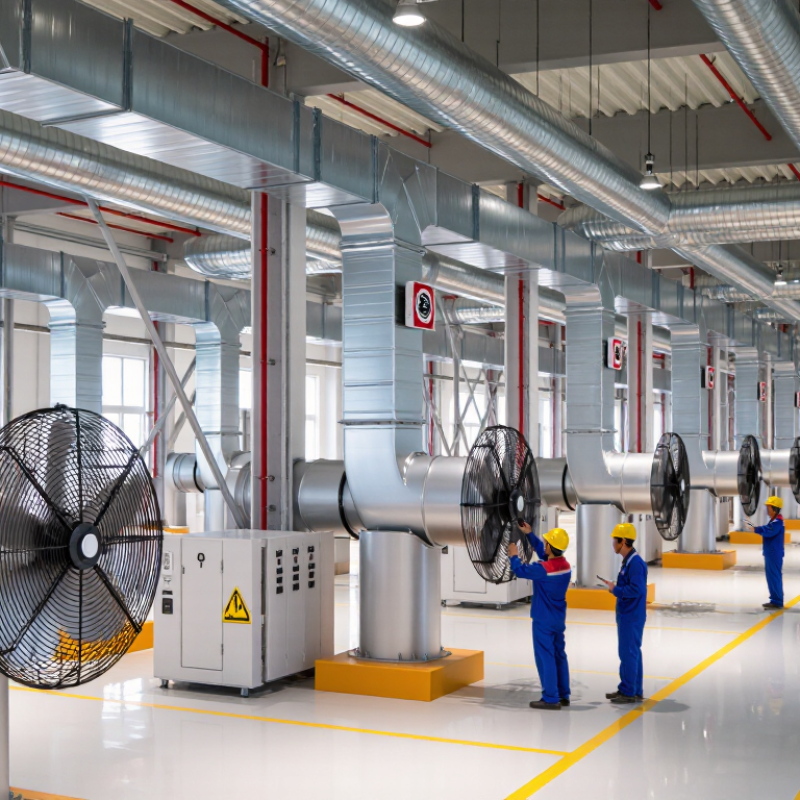
Axial fans suit high airflow at low resistance, such as warehouse ventilation, cooling lines, and general air movement.
Centrifugal fans handle higher static pressure and work better with ductwork, filters, scrubbers, or long exhaust routes.
Mixed-flow fans can balance both needs where space is limited.
The air itself also determines the fan type. For dusty processes, select a design that tolerates particle exposure and allows simple cleaning. For hot air, verify the motor, bearings, housing, and impeller temperature limits. Corrosive vapors require compatible construction materials and careful sealing. In classified environments, use equipment certified for the site conditions and follow local installation requirements.
Small details matter. A greasy filter can change the operating point and reduce airflow.
I have seen teams choose a fan by horsepower alone, then discover poor ventilation after installation. That approach needs reconsideration. Measure airflow, static pressure, temperature, humidity, noise limits, and available space before purchase.
Check the performance curve at the actual system resistance, not just the advertised maximum. Leave access for belt adjustment, inspection, and cleaning.
Energy use also deserves attention; a slightly higher purchase cost may reduce years of operating expense.
Still, calculations are not perfect. Real duct losses, process changes, and neglected maintenance can alter results, so commissioning measurements should confirm the final selection.
Evaluate Size, Materials, and Environmental Resistance
Choosing the Right Industrial Fans: Size, Materials, and Environmental Resistance
Selecting an industrial fan starts with the air it must move, not the catalog image. Measure room volume, duct length, outlet restrictions, airflow demand, and static pressure. A fan with impressive airflow may perform poorly against long ducts or clogged filters. Measure twice. Dust changes everything.
During site assessments, I have seen oversized fans waste energy and create uncomfortable drafts. Undersized units often run continuously, increasing heat and maintenance costs. Check operating temperature, humidity, airborne particles, and required noise limits before choosing motor capacity. Consider variable-speed control where demand changes throughout the day. Confirm the fan’s actual performance at your system’s pressure, rather than trusting free-air ratings.
Material selection should match the environment. Coated steel can suit ordinary indoor areas, while stainless steel or corrosion-resistant alloys may perform better near moisture, chemicals, or salt air. For dusty locations, inspect sealing, protective guards, bearings, and motor enclosure ratings. High temperatures also require suitable insulation, lubricants, and components. I once underestimated seasonal humidity during an assessment; the equipment worked, but corrosion appeared earlier than expected. That mistake reinforced the value of reviewing maintenance records and environmental data. Ask for test documentation, installation guidance, and applicable safety certifications from qualified suppliers. A careful engineer should still question incomplete specifications.
10 Tips for Choosing the Right Industrial Fans
Evaluate size, materials, environmental resistance, operating performance, and long-term maintenance requirements before selecting an industrial fan.
This 100-point engineering screening model gives the highest priority to airflow, static pressure, material durability, and environmental resistance. Confirm the final selection against site measurements, applicable safety requirements, and the fan manufacturer’s certified performance data.
Compare Energy Efficiency, Noise, and Maintenance Needs
10 Tips for Choosing the Right Industrial Fans
Tip 1: Check energy efficiency at the fan’s actual operating point, not only its peak rating. A fan may look efficient on paper but waste power when oversized. Tip 2: Compare motor efficiency, airflow, static pressure, and controls together. Tip 3: Consider variable-speed control for changing production demands. It often reduces unnecessary energy use. Measure the load.
Tip 4: Review noise levels in decibels under realistic conditions. Tip 5: Ask where the noise was measured and whether ductwork was included. A quiet fan can become loud after installation. Tip 6: Inspect blade balance, vibration limits, and mounting requirements. I have seen small alignment errors create persistent noise. Tip 7: Protect workers near occupied areas with suitable acoustic planning.
Tip 8: Study maintenance access before purchasing. Filters, bearings, belts, and guards should be reachable without unsafe workarounds. Tip 9: Request service intervals, replacement part details, and inspection procedures. Tip 10: Compare the total operating cost over several years, including cleaning and downtime. Reliable selection depends on verified testing, clear documentation, and advice from qualified engineers. No choice is perfect. A slightly less efficient fan may suit a dusty process better, while a low-noise model may require more frequent cleaning. Recheck assumptions after installation.
Verify Safety Standards, Installation, and Supplier Support
Choosing an industrial fan starts with safety, not airflow. The U.S. Department of Energy’s Improving Fan System Performance: A Sourcebook estimates that fans can consume 15–20% of industrial electricity. Incorrect selection can therefore increase both energy costs and mechanical risk.
Check whether the fan meets recognized requirements, such as AMCA 210 testing, IEC 60204-1 electrical safety, and suitable guarding practices under OSHA 1910.212. Ask for test curves, noise readings, motor protection details, and materials compatibility. A missing guard is not a small oversight. It can expose workers to rotating components, loose clothing, or expelled debris.
Installation quality matters just as much. Verify anchor strength, duct alignment, flexible connections, access clearance, and vibration limits. During commissioning, record amperage, rotation, airflow, and bearing temperature. I have seen projects accept a fan based only on its catalog airflow. That shortcut is risky. Real systems often have higher resistance than expected.
Supplier support should include drawings, manuals, spare-parts availability, training, and a named technical contact. Request a written response-time commitment.
Also ask who handles startup problems after delivery. The U.S. DOE sourcebook recommends system-level evaluation, yet buyers still compare fans by price alone.
That decision deserves another look. A practical installation checklist may prevent an expensive correction later.